

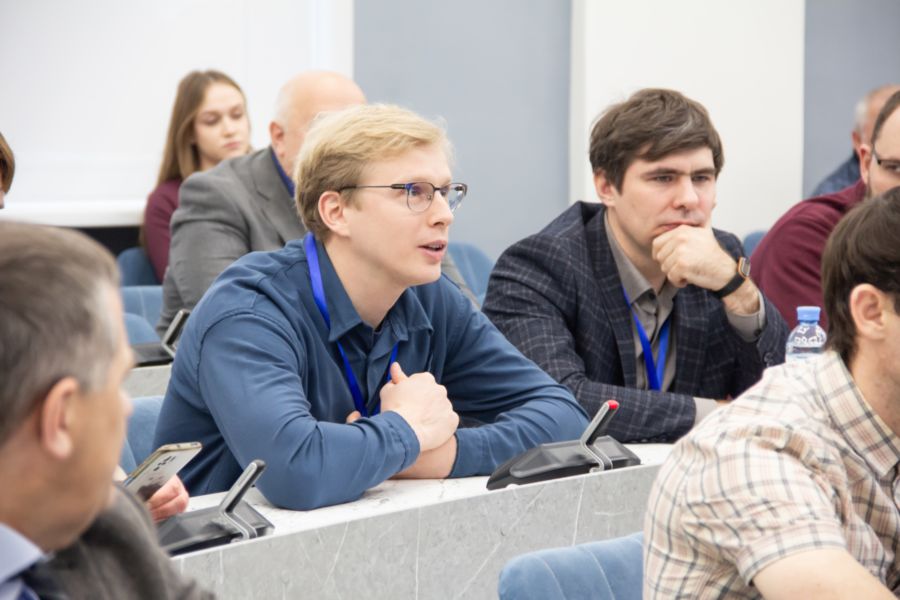
On December 17th, the 5th Science-to-Practice Seminar on "Quantum Technologies: Quantum Sensorics" wrapped up at South Ural State University.
This event closed with a roundtable discussion on "Quantum Sensors: From Fundamental Research to Practical Applications". The discussion was moderated by Aleksandr Sergeev, Academician of the Russian Academy of Sciences (RAS) and Scientific Director of the National Centre for Physics and Mathematics (NCPHM). Participants included Dmitry Bisikalo, Deputy Scientific Director of the NCPHM and Academician of the Russian Academy of Sciences; Mikhail Romanovsky, Deputy Director of the Centre; Vasily Velikhov, Project Manager of the Inter-University Quantum Network at the Kurchatov Institute; Stanislav Davydenko, Group Leader at the NCPHM; Georgy Elizarov, Scientific Director of the KVANT Research Institute; Andrey Korolkov, Vice President of the Academy of Cryptography of the Russian Federation; and Sergey Kulik, Head of the SUSU Quantum Engineering of Light Laboratory. During the seminar, participants discussed the creation of ultra-precise optical clocks (with an accuracy of 10-15); application of quantum gravimetry (how to peer inside a volcano and assess the state of magma); quantum technologies in medicine, cellular biochemistry and DNA sequencing; quantum computing and cryptographic algorithms. Experts noted the need to develop a roadmap for quantum sensing and pointed out the challenges of assessing the quality of quantum technologies.
Speaking on the opening day of the seminar, RAS Academician Aleksandr Sergeev called Chelyabinsk one of the capitals of the "second quantum revolution".
"There are two components to organizing science: first, high-level specialists, and second, government support," said RAS Academician Aleksandr Sergeev. "Chelyabinsk meets both requirements. A distinguished scientist, Sergey Kulik, has established a laboratory in your city. Interesting results have been obtained there, and we have heard insightful presentations about them during the seminar. Second, it is the attention of Governor Alexey Texler. When regional leadership supports science, business representatives take the project seriously. We are also interested in other projects in your region, for example, those related to the nuclear centre in Snezhinsk."
Academician of the Russian Academy of Sciences Aleksandr Sergeev noted the keen interest of the university youth in quantum issues.
"When it comes to quantum technologies, we need young people with a sparkle in their eyes who have the necessary professional skills to develop them. And for this to happen, the existing education system must develop appropriate programmes and courses. Several leading universities in our country (MEPhI, MIPT, and MISIS) are currently developing such programmes, and joint work is planned with universities in BRICS countries. And there will be no shortage of young people eager to study," RAS Academician Aleksandr Sergeev expressed his hopes.
The round table wrapped up with a tour to the SUSU Quantum Engineering of Light Laboratory, headed by the leading researcher Sergey Kulik.