



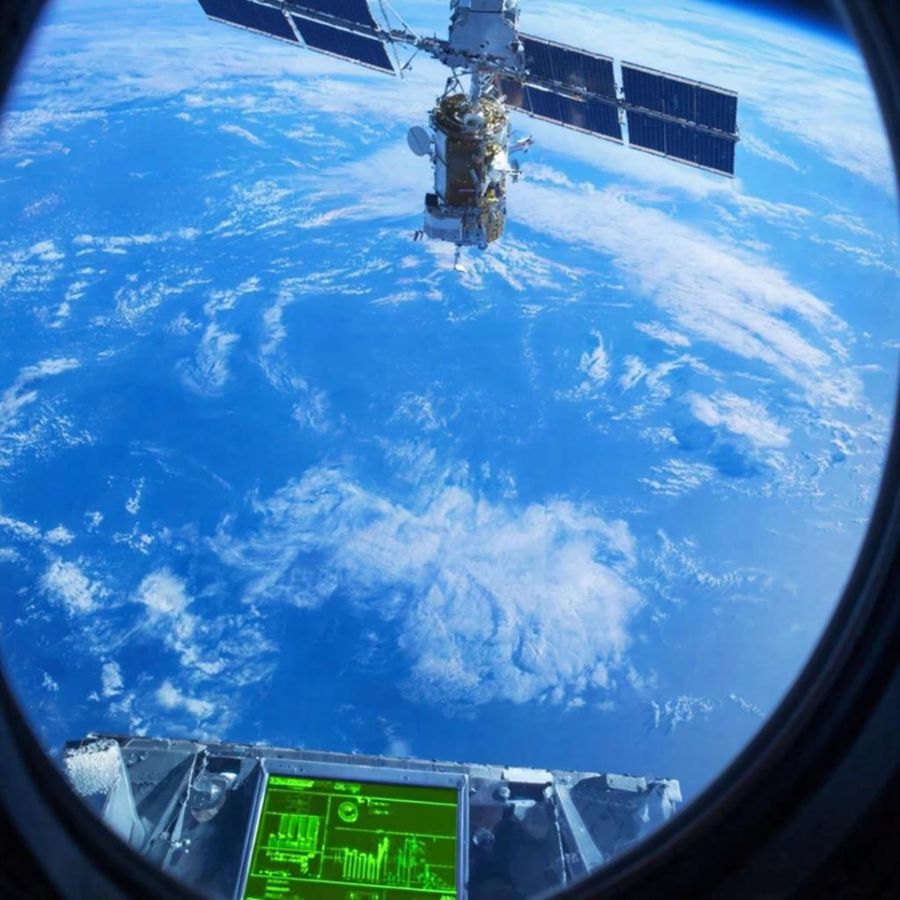
For the first time in Russia, SUSU scientists, jointly with their colleagues from the Chelyabinsk Centre for Hydrometeorology and Environmental Monitoring and the Yakutsk Scientific Centre of the Siberian Branch of the Russian Academy of Sciences – Institute of Physical and Technical Problems of the North, are implementing a big-scale project to develop and use methods of remote sensing from space to monitor environmental pollution.
Tatiana Krupnova and Olga Rakova, associate professors of the Department of Ecology and Chemical Engineering, represent South Ural State University in the project. The work has been ongoing for several years and is supported by a grant from the Russian Science Foundation.
The first results have been published in a highly rated journal on "Modern Problems of Remote Sensing of the Earth from Space", which is included in the Scopus database of scientific periodicals.
The task of scientists is to determine how and under what conditions ground-level ozone is formed in urban environments by monitoring formaldehyde and nitrogen oxide levels using satellites.
For the first time in Russia, a well-known observation methodology based on data from the Sentinel-5P (TROPOMI) satellite is being applied to urban conditions.
"We have experience using satellite data, for example, from the Landsat satellite," explains Tatiana Krupnova. "Together with our colleagues from Yakutsk, we have already studied the greening of the city of Chelyabinsk using the NDVI index and the condition of the Korkinsky coal mine using the snow pollution index. Now we are working with data from the Sentinel-5P satellite (which carries the TROPOMI tool), launched in 2017 by the European Space Agency from the Plesetsk Cosmodrome as part of an international mission to observe the chemical composition of the atmosphere from the Earth orbit. We compare the mathematically processed satellite data with ground-based measurements, which we receive from the Chelyabinsk Centre for Hydrometeorology and Environmental Monitoring."
Ozone is one of the most dangerous air pollutants and is one of six substances used to calculate the air pollution index in Chelyabinsk.
Ozone is not emitted by any industry; it is formed in the atmosphere as a result of sunlight interacting with nitrogen oxides and volatile organic compounds (VOC). VOC themselves are converted into formaldehyde in the atmosphere.
"The ratio of formaldehyde to nitrogen oxides, obtained from satellite data, can be used to assess ozone formation patterns," explains Olga Rakova. "We are the first to apply this approach to a Russian city. In Chelyabinsk, VOC emissions must be reduced in order to reduce ozone concentrations in winter, and nitrogen oxide emissions in spring, summer, and autumn."
However, the dependence is nonlinear. If nitrogen oxide emissions are reduced sharply, as happened during the pandemic in spring of 2020, ozone concentrations will increase again. From May 4th to 16th in 2020, during the lockdown, abnormally high ground-level ozone concentrations were observed, ranging from 270-290 μg/m³ (with an average daily MPC of 30 μg/m³). Therefore, it is important to reduce not only nitrogen oxide and VOC emissions, but also to find the optimal balance between them, which is unique to each city. For Chelyabinsk, the critical formaldehyde to nitrogen oxide ratio, determined using satellite data, is in the range of 1.0 to 1.8, according to the scientists.
Analysis of Russian satellite data will also be used in another project: the development of a methodology for assessing the effectiveness of environmental protection activities in specially protected areas, commissioned by the Ministry of Ecology of the Chelyabinsk Region.