


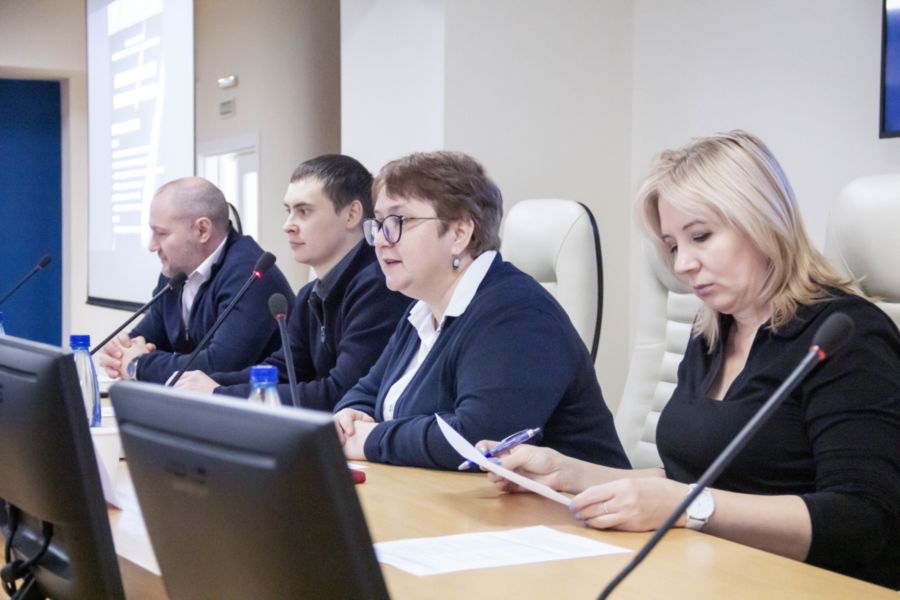
Twice a year, during this conference, students present their achievements in experimental and project activities, as well as new scientific developments and technologies are introduced. Over the two days, thirty-four reports by school children, 1st and 4th-year students, and postgraduates were heard at the scholarly meeting.
The main conference topics included the issues related to the design, control systems, power supply for rocket and space equipment and unmanned aerial vehicles.
Invitations to participate in this event had been sent to scientific centres and teams, organizations of secondary education, manufacturers of aerospace equipment and developers of training materials, Russian researchers and inventors, teachers, postgraduates, students and school pupils.
Thus, a student of the SUSU Department of Aircrafts Kseniia Kirpichnikova presented her overview of spacecraft for solar wind studying and shared on the prospects in this field of research.
“In our research, we examine the methods and tools of studying the solar wind – an electrojet current which is continuously emitted by the Sun,” explained Kseniia. “We need to study the solar wind in order to be able to predict geomagnetic storms (to protect the networks, communications, and satellites) and ensure the safety of cosmonauts and equipment on the orbit. Today, the solar wind is studied by measuring the parameters of plasma, monitoring the magnetic fields, analysing the wind’s composition, and by remote observations of the solar corona. In the future, for a more in-depth and precise studying of this phenomenon, we would need apparatus with better sensors and radiation resistance of devices, and capable of flying up close to the Sun. AI could also be helpful in the prediction of solar events.”
On day two, fifteen reports were presented covering the topics of using neural networks for strength calculations, using gravitational lensing for direct observation of exoplanets, using metamaterials for aerospace engineering, and much more.
A student from the same Department, Vladislav Prizentsov, had prepared a report on space-based solar power engineering: “The topic of space-based solar power engineering is one of the most promising ones in the field of sustainable power generation of the future. There already exist such projects as, for instance, SOLARIS by the European Space Agency, or the American Space Solar Power Project, under which a prototype of a space solar power plant, SSPD-1, was successfully launched to the orbit in 2023. Space-based solar power engineering has substantial advantages: continuity of generation, high solar radiation intensity in space, and environmental friendliness. However, the problem of expenses on such technologies has not been solved yet: high cost of launching special-purpose satellites, difficult assembly of gigantic structures on the orbit, and the still low total efficiency of the power transmission chain. I believe that if the launch costs are reduced and the efficiency of technologies grows in the future, space-based solar power engineering could become a real source of clean energy already by the middle of the century.”
After all the reports were presented, the conference results were summed up and the participants and their research advisors were awarded.
Among the jury members during day two were: Deputy Director of the Institute of Engineering and Technology Ekaterina Zarnitsyna, Associate Professor of the SUSU Department of Aircrafts Aleksandr Terekhin, Department’s senior lecturers Evgeniy Mikhailov, Iuliia Baranovskaia and Iuliia Siuskina, design engineer of the SUSU Laboratory for Launch Vehicles, and Unmanned and Aerospace Vehicles Aleksandra Shablei, as well as senior lecturer of the SUSU Department of Aircraft Engines Elena Sulatskaia.
Following the results of the 12th and 13th conferences, “Asteroid Safety” collected papers (included in the Russian Science Citation Index) will be published in the 2025-2026 academic year.